1001 FACES contact sheets

Thursday, April 7, 2011

My Bedouin Wedding

If you do not live among a Bedouin community, getting invited to a Bedouin wedding is very unlikely.
That morning I took the bus to Madaba and from there to Ma'ine thinking that the baths of Ma'ine would be there or very close.  When in Ma'ine I learned otherwise and I asked the cab driver to take me to meet some Bedouins nearby so I could get a feel of how they live and get a taste of their culture.  He did not waste any time and dropped me in front of the biggest Bedouin tent I had ever seen, only it was set up for a wedding reception.   Too late to turn back.  There was an old Bedouin looking my way and probably wondering what this stranger is doing in these parts of the world.


What I saw when the cabby dropped me off.

The old man invited me "in" and offered me coffee and tea and while we were chatting some people came by, so I met the groom and his father that a bit later took me to view the dinner preparations which were already under way.   There is a couple of graphical images below, sheep slaughtered.. so be forewarned. 


Kids learning!


The sheep are paying the ultimate price for this occasion.

The groom.


My host, a groom's family friend, and the groom.

The groom and his father.

Well wishers could stop by anytime.  Coffee and tea always ready.

Charcoal brewed..


"Take a picture of the flag" the old man said.  "This flag is very dear to us".

Not so traditional are the rented red chairs.
 My host described to me the timeline of events in a typical Bedouin wedding.  You may want to visit "Anatomy of a Bedouin Wedding" for all the complete details.  There is a video clip too of the host explaining all the event in Arabic which I translated.


 After telling me about the wedding customs, the old man invited me to attend the wedding festivities which I gladly accepted.  The way to accept such an invitation and yet leave room to get out of it is to say "inshallah"  (God willing).  The invitation comes as a way to honor a guest or someone, specially a stranger, it is part of the Bedouin Arab culture.

Some little things in life matter and are in most places taken for granted.  Case in point:  this big reception area offered no facilities.  That meant that I had to manage a ride back to Amman late in the night as Ma'ine nor nearby Madaba offered any hotels.  Anyway, I had to get back to Amman, since it was still very early in the day.  I wanted to get my camera flash and a couple of other items.  That also meant more time for me to evaluate if that was such a good idea.

Well, this was literally once in a lifetime chance to experience something different at many levels.  The fact that you do not get to see the bride and be warned not to take pictures of women in the remote chance that you might see one is one of these rare things.  The women by the way were in regular homes across the field where only the groom is permitted to go at one point and see his bride.

This was an authentic Bedouin wedding untouched by trends of westernization (except for the groom western style suit)..  Back in the city, Amman, a wedding, Muslim or Christian would more resemble western style weddings in terms of packaging, presentation, food and drink, music and dance etc..

So, back to Ma'ine for the wedding festivities.


The bride lives in a nearby village in the Mount Nebo area.  A whole caravan goes out to get her..  Along the route people come out of their houses to see and cheer on.


A baby anything could almost steal the show.. a baby horse!!


It didn't take long to secure the bride and bring her back to Ma'ine.
The next event is one for the groom.  At a nearby friend's house he goes to get bathed and dressed up.  Another caravan follows.  He comes out and sweets are served and then back to the "reception" tents or "houses of hair"  (byout sha3er) as the Bedouins call them.


Below is what they call "Al Zaffa", just what you see, the groom is escorted to the main reception area after seeing the bride.


The groom greets the well wishers.  Again, don't expect the bride to come by and say hello.  It is not in the tradition.  She would be with all the family ladies, young and old, celebrating in the "stone" houses.


It's getting dark, the sun just set and it's time for prayer. 


Chatting, coffee, tea and waiting for dinner.


The one that needs no translation: the universal smile :)


Ladies and gentlemen, well, here just gentlemen:  dinner is about to be served.  What took all day to be readied is about to be consumed in a matter of 5 to 10 minutes.


Yogurt, from a pre-dried "stone" form of yogurt.

Traditional "Mansaf"  can't be more authentic than this!  (from that morning!) The mutton meat is served over rice and bread with the yogurt.  It is eaten traditionally by the right hand while the left hand is kept behind one's back.

Come and get it.


only right hands sharing a meal


Very old Bedouin poem recitation performed by a group of men.

I have captured some of that sound.  You can hear it in another post titled :"Anatomy of a Bedouin Wedding".

Mabrouk!
Congratulations!
the end of Thursday's festivities
Very little goes on Friday.  Some well wishers after Friday prayers and Saturday the couple heads to a honeymoon destination.

Sunday, April 3, 2011

If anything is, this is.. Jewish


At the wailing wall, no one is picking up the mail.

Prayers go unanswered while prayers and wishes are written as proof of piety and obedience.  They write their prayers down on a  piece of paper and then they, the writers, fold it into many layers until it is small enough to fit inside the crack of a rock.  There, it stays.  I saw some that fell out of the rock and onto the ground.  No one seems interested in picking them up and placing them back into the wall.  A good Samaritan by his nature would.  Maybe it is thought that the fallen ones are "destined" to be "lost" and interference is not encouraged.  Hmm, how much superstition is infused into religions in general?

I suggest people put a return address, or enough postage.  It does not seem that this mail/prayer on paper is going anywhere.  Maybe not picking up the mail is God's message to his people:  "nag, nag, nag... or  Gone fishing" or a case of "return to sender, address unknown"?.

Sorry, I couldn't help but notice, the mail is not getting picked up.  Have you searched facebook:  type gee oh dee and hit search!  Nope, He's not on facebook either.  Well good luck next time.  Meanwhile, keep the tradition, write it, fold it and stuff it.

The site features a wall.  This one is for prayer.  Jews pray here.
On the other side and above is the Aqsa Mosque.  Muslims pray there.  The Jews want the site of the Aqsa to "rebuild" their temple. 


Dear God, about the other wall of "separation"...
By the sign of the hands..most likely not Jewish!

I would get the contractor to replace that "defective" stone..

The postman never comes here :(

some prayers fall on deaf grounds.

Still waiting and hoping.  Yellow is more attractive!

Safe harbour. 
found a good spot yet?

a symbol of peace.  Pigeons and animals like a human smile (see below)  are non religious and non racial

God only knows..

slow business for religion today!

a smile is a human trait (it has nothing to do with religion or race)

is digital Kosher?

Dear God: for starters I want a nice jewish BF oh sorry, that's boyfriend....  ps I love you.

Tuesday, February 22, 2011

Silhouetting, Wadi Rum, Jordan


Wadi Rum, Jordan is what they say it is.  There, when tourists are not jeeping around, or expressing how beautiful and stunning this place is and when cameras' shutters shut up, then you can hear the sound of silence.  At night, and no matter how bright the stars communicate their presence you can still hear the sound of silence.  The sun was setting on the "Valley of the Moon".   Some were waving goodbye!


Friday, February 18, 2011

Oud and Tawlet zaher (big bellied guitar and backgammon) on Makhoul Street


So I made it to Makhoul Street (Mak7oul) in Ras Beirut, my street.  Now I understand why older people tend to have that sparkle in their eyes on occasion, a hesitant tear is the sparkle and yet, often, even the tear is smiling.  The sight, the smell and the sounds awaken memories, among other things,  of one's youth, past so many moons and suns.  I guess I had my share of those and found myself at the edge of a sparkle as I entered Makhoul Street.

The Mokhtar's office where I found Abou Faddoul's photo.
Looking at my little street without reconciling between what is and what was is impossible.  In my mind I see and superimpose pictures of the way I knew how things were.  Much of the street's structures and old buildings are gone, some have changed and very little remains the same.

Abou Faddoul and his shop (a pet store in 2010).
The fruit and vegetable vendor still comes pushing a 3 wheel cart using an old style scale.  I talked a bit to the vendor.  Over my stay in Beirut I got to see him set up at different locations.  Once I mentioned to him this old sound that I remember, sounded by another vendor like him:  "sabi3 el bubbu ya 5iar"!  his immediate reaction was: " Allah yir7amak ya .. ".  Apparently not just any vendor would go around calling on his cucumbers the same way and comparing them to the fingers of babies as if the call for the little cucumbers was unique to this man, as if it were a signature call that he, the vendor I was talking to,  associated with someone he knew and had passed on.."May God have mercy on you.. " was his reaction of his friend.

A different look, miss the "jarassiyeh" and the big bell
At the end of the street, Makhoul street and Abdul Aziz street, at that corner a seasonal 3 wheel carter would set up.  Corn on the cob, chestnuts, sour plums (janerik) and salt, green almonds and salt, shaved ice and summer drinks; but the smells that went up the street were those of the corn and chestnuts.  No, no such vendor anymore, not on this corner.

Abou Faddoul had red hair a Oud and a backgammon table, a general store and a bunch of friends, plus a unique air conditioning system..  I lived across the street from Abou Faddoul and looking down through the window I could see him and hear him play the oud often.  On a hot  lazy summer afternoon, the sun would be directly shining on his store but on the opposite side of the street, the sidewalk is shaded by a long wall that fenced in a building used as a public school.  Even though it's shady, it remains very hot from the noon sun pounding on the street's asphalt.  Abou Faddoul would bring a jug of water and with a right to left, left to right motion would sprinkle water on the hot blacktop.  The result is a cooling evaporating effect.  Now, there on the sidewalk, in the shade and the Abou Faddoul air conditioning system, Abou Faddoul and friends sit around a backgammon table.. yalla  habbel yek.

The Mokhtar's office sat at the corner of Makhoul and Jeanne D'Arc streets and recently closed down since the passing of Kamal Girgi Rubeiz.  This is one of the old buildings that remain on the street and there is talk of turning it into a museum of sorts.  The church was modernized and now has air conditionning, The Jarassiyeh is gone and so is the big bell.  The small bell remains for show.  The yellow stone columns were removed, two of them are used behind the church for decoration..

What I miss the most on Makhoul Street is my grandmother's jasmine tree.

- . - . -

all content ©  Simon Sakkab
Abou Faddoul's photo photog. is uknown. taken with permission.

Wednesday, February 16, 2011

The Anatomy of a Bedouin Wedding


What's good news for two families is in this case very bad news for almost a small herd of sheep as the sheep made the menu honors for a few hundred guests of a Jordanian Bedouin wedding.

I stumbled upon this wedding by sheer coincidence.  I wanted to meet a Bedouin family and see how they lived but ended up meeting the whole tribe.

It was still early morning and the cab driver dropped me off where a Bedouin wedding was to take place.  There was a large or I should say huge L shaped tent or tents, lined with floor cushions to seat guests and they had rental chairs as well delivered for the evening activities.  A large Jordanian flag was in the center of the "court" area and a small stage.  At one point during my visit one elder asked me to take a picture of the flag saying "hatha 3aziz 3aleina" meaning this flag is very dear to us.

A man was at the edge of the tent looked my way as I was being dropped off, curious I guess as to whom this guest might be.  I walked towards him and told him how I ended up at his door step, except that there was no door.  He welcomed me and offered me some tea.

So we sat down on the floor cushions and I asked him to describe the differents activities involved in a Bedouin wedding.  I recorded this almost six minute description as he went through a Bedouin Wedding timeline.  Since it's in arabic, I will give a summary of what he said in english.

On Tuesday, the houses of hair (byout el sha3er), reference to the tents and the animal "hair" they're made of, are brought and set up, as well as the chairs.   Nothing special takes place on Tuesday night.


On Wednesday, the party starts in the evening. There would be some live music, and a lot of people would come.  There would also be what is called "Samer el Badawi" where old Bedouin poems are recited.  These poems are themed on praise, pride and any reference to the bride's beauty is kept on a very conservative side.
The party goes on, tea and coffee are served, and recently, from about 10 years ago they started getting
a videographer to continuously record the event and activities.  Throughout of course the women would be in the "stone" house (modern house), dancing and singing.

On Wednesday the bride goes to the "Salon" where the groom, and groom only, goes to pick her up from the "Salon" and take her to a "hall" where they have a party for the bride.  The groom and his mother offer and put on the bride gold jewelery at the hall event.  The groom is the only male present at this hall.  He would dance with the bride and later take her to her father's house after the "Talbiseh", as this party is referred to, meaning putting on the gold on the bride.

Thursday, which happened to be the day I got there, the  sheep pay the ultimate price.  Dinner preparations start on Thursday morning with the slaughter.  About 250 "mansafs would be prepared for the men and about 50 for the women depending on attendance.

At around 6PM, men and women separately board a number of cars and make the trip to the bride's house, or her father's to get her.  They would be going to the Mount Nebo area.  The groom's party would ask for the bride's hand (these are formalities) and the bride's father would put his head dress on his daughter as she leaves his house and puts her in the care of the groom.
The bride is brought back to the groom's father's house (where all the women gather).

My host omitted that after coming back from Nebo the groom is taken to a friend's house where he is bathed and dressed and another convoy of cars goes to get him with much celebration.

Later dinner would be served and around 10PM the groom goes to his father's house where the bride is celebrating with other women.  There, again, he is the only male allowed to see her, would celebrate and dance and then take her to his house which happens to be 40 yards away.

Friday, people show up after the Friday prayers, they are served lunch, more sheep, and the celebrations end at this point.  The bride and groom would soon thereafter leave for their honeymoon destination.  Sharm El Sheikh, Egypt is a popular spot.  Also Damascus or Turkey.

I was invited to attend the festivities later in the day and to photograph the activities except two things I was warned not to photograph: women (not that they mingle among men) and "happy" firearms that are traditionally fired in celebration but such practice is or is becoming illegal.

So this is the anatomy of a Bedouin wedding.  Another post may describe what actually happened along with some cultural observations and comments and still pictures.

Until then, salamu aleikom.


Anatomy of a Bedouin Wedding.


"Samer El Badawi" I couldn't understand one word and it's supposed to be Arabic!


Monday, February 7, 2011

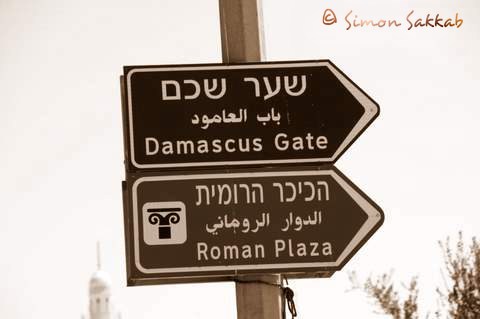
Damascus Gate, Bab Al Amud. July 2010

It is named after something that is no longer there.  Its placement was a symbol of victory.   The name remained as a reminder of a long gone era.  This land's history is as such: 
they come, they see and they leave, eventually!
(but that's another story)

Location: Jerusalem, Al Quds

Bab Al Amud is the gate of the Column, in reference to the Roman "victory" Column that was placed by the Romans in front of the gate.    The column is documented in the Madaba Map:  A mosaic depicting the gate and a representation of the Amud that was there once upon a time. Is it burried waiting to be found or did it find a new home? Or was it recycled into another structure?
The present gate is made of wood planks (see photos below) covered by strips of metal,  It is fair to say they don't make them like this anymore!